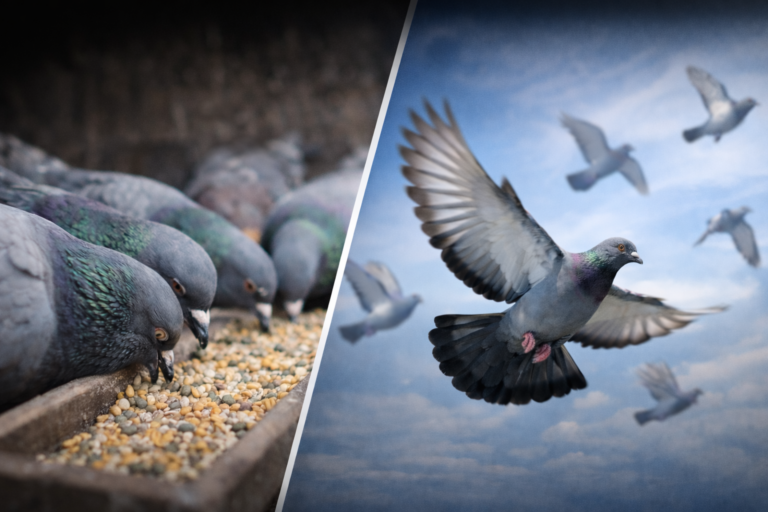

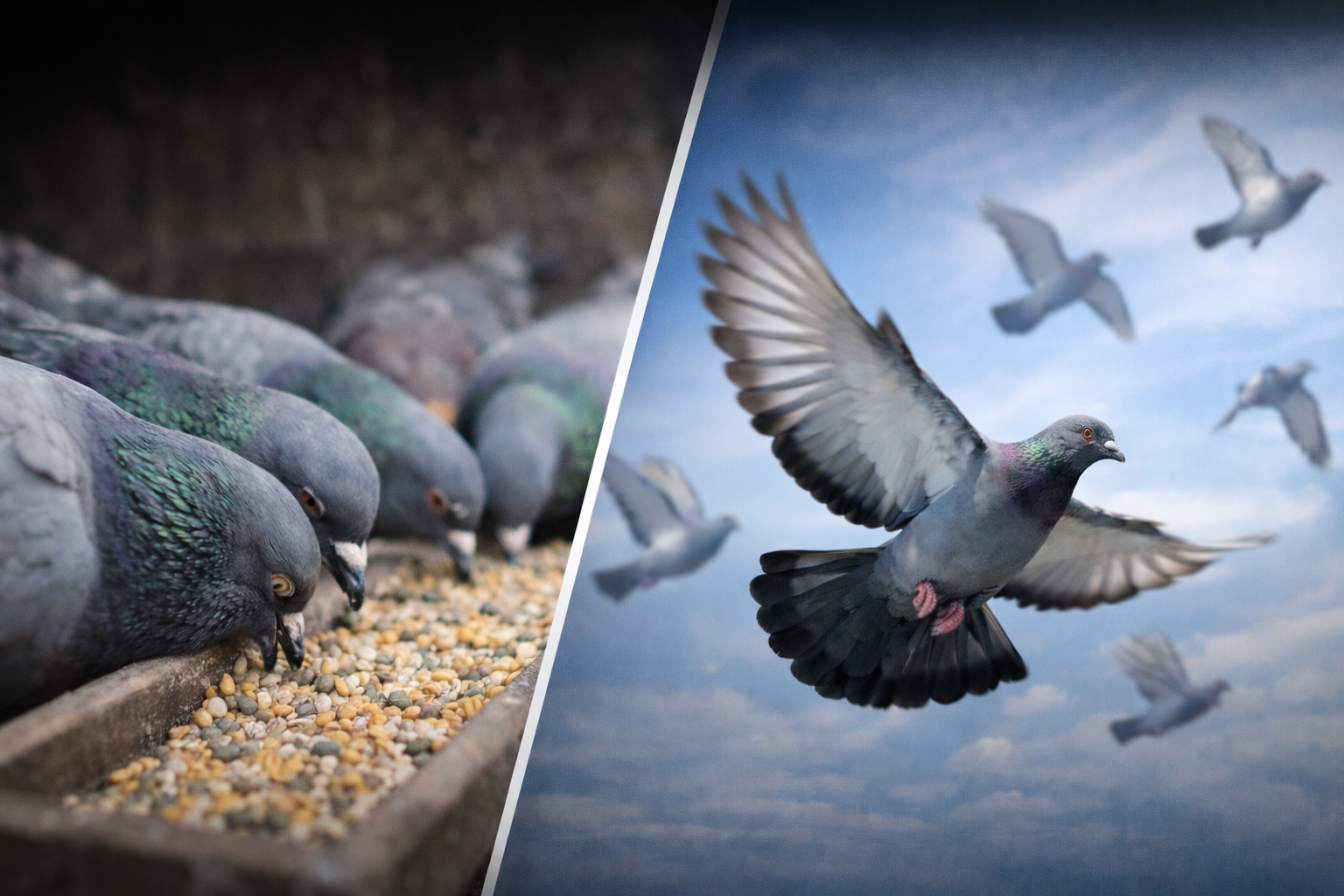
When most fanciers talk about feeding racing pigeons, the conversation usually sounds the same.
What mix are you using?
How much protein?
Do you add fats before basketing?
What supplements are you on right now?
These are all valid questions — but they often miss something far more important.
The truth is, most feeding programs are designed to keep pigeons alive and healthy, not to consistently support performance under stress. And there is a meaningful difference between the two.
A racing pigeon that looks healthy in the loft is not automatically a pigeon that is nutritionally prepared to race week after week. That gap — between survival nutrition and performance nutrition — is where many lofts unknowingly limit themselves.
This article isn’t about promoting a new grain or supplement. It’s about rethinking how feeding actually works in a racing pigeon’s body — and why performance is often decided long before race day ever arrives.
Feeding Racing Pigeons: Survival Nutrition vs. Performance Nutrition
A pigeon’s nutritional needs change dramatically depending on what is being asked of it.
At rest, a racing pigeon requires enough calories, protein, vitamins, and minerals to maintain body condition, feathers, and basic health. Most commercial feeds and traditional systems handle this just fine.
But racing introduces a completely different environment:
- Repeated physical exertion
- Neuromuscular stress
- Mental load and orientation demands
- Hormonal shifts
- Cumulative fatigue
Under these conditions, “enough” is no longer enough.
Many racing pigeons fail to perform not because they are underfed, but because they are fed incorrectly for the phase they are in. Performance nutrition isn’t about more feed — it’s about timing, purpose, and recovery.
Feeding Is a Form of Communication
This is a concept most fanciers never consciously think about:
Feeding communicates signals to the bird’s body.
Every meal tells the body something:
- Prepare for work
- Recover from work
- Store energy
- Repair tissue
- Stay idle
When feeding is random or static, those signals become blurred.
For example:
- High-energy feed given too late signals storage, not performance
- Heavy protein without recovery timing signals strain, not repair
- Constant “rich” feeding signals rest, not readiness
Over time, birds become nutritionally confused. They may look fine, but internally they are always a step behind the demands placed on them.
A true performance-focused approach to feeding looks at what signal the bird needs at that moment, not just what’s in the trough.
This philosophy is one of the core ideas behind structured approaches like the Performance Feeding System — feeding with intent, not habit.
Why Birds Don’t Fail on Race Day
One of the biggest misconceptions in pigeon racing is that a poor performance happens on race day.
In reality, most failures happen days earlier.
Race day simply reveals what was already set in motion:
- Incomplete recovery
- Poor energy timing
- Accumulated stress
- Misaligned nutrition
By the time a pigeon is basketed, very little can be “fixed.” At that point, the bird is running on whatever foundation was built earlier in the week.
This is why fanciers often say things like:
“They trained well, but didn’t race well.”
Training performance does not always expose nutritional gaps. Racing does.
The Hidden Role of Recovery Nutrition
Recovery is where many feeding programs quietly break down.
After exertion, the body prioritizes:
- Muscle repair
- Glycogen replenishment
- Nervous system recovery
- Hormonal balance
If recovery nutrition is delayed, incomplete, or mismatched, the bird never fully resets before the next demand. The result isn’t always dramatic — it’s gradual.
You see it as:
- Slower week-to-week performance
- Birds that “flatten out” mid-season
- Longer bounce-back times
- Loss of sharpness
This is why performance feeding must be viewed as a cycle, not a daily routine.
Systems like the Performance Feeding System emphasize feeding phases — before work, after work, and between races — because recovery is not optional in a competitive environment.
Timing Matters More Than Ingredients
Many fanciers obsess over ingredients while ignoring timing.
Two lofts can feed nearly identical mixes and get very different results simply because of when those nutrients are delivered.
Examples:
- Energy fed too close to basketing may not be usable
- Protein fed without adequate recovery time creates metabolic stress
- Fats fed without workload context lead to sluggishness
Timing aligns nutrition with physiology.
Performance feeding is less about chasing the “perfect mix” and more about understanding when the bird can actually use what it’s given.
When it comes to Feeding Racing Pigeons, most problems don’t come from a lack of effort, but from feeding that isn’t aligned with workload, stress, and recovery.
This shift alone often creates noticeable improvements — even without changing brands or supplements.
Stress Is a Nutritional Variable
Stress is not just mental — it is biochemical.
Training, transport, handling, weather, and racing itself all elevate stress hormones. These hormones directly affect:
- Digestion
- Nutrient absorption
- Energy utilization
- Recovery speed
Ignoring stress while focusing only on feed composition is a mistake.
A performance-focused feeding approach accounts for stress by:
- Supporting recovery windows
- Avoiding constant overload
- Matching nutrition to workload intensity
This is why rigid “one-size-fits-all” feeding plans often fail under real racing conditions.
Why Most Feeding Plans Create Performance Ceilings
Traditional feeding plans tend to work… until they don’t.
They are often:
- Static
- Habit-based
- Season-agnostic
- Performance-blind
At a certain level, birds stop improving not because of genetics or training, but because the feeding approach no longer supports higher demands.
This creates a performance ceiling — one that many fanciers never realize exists.
Breaking through that ceiling requires treating feeding as a system, not a checklist.
That’s the gap modern frameworks like the Performance Feeding System are designed to fill — helping fanciers move from “good enough” feeding to purpose-driven performance nutrition.
Feeding for Clarity, Not Complexity
One concern many fanciers have is that “performance feeding” sounds complicated.
In reality, the opposite is true.
When feeding is based on purpose — preparation, performance, recovery — decisions become clearer, not harder.
Instead of guessing:
- You know why you’re feeding something
- You know when it matters
- You know what to adjust when performance slips
That clarity is often what separates consistent lofts from inconsistent ones.
Final Thoughts: Feeding Is Part of Training
Feeding should not be treated as separate from training.
It is training — just at the metabolic level.
When nutrition aligns with workload, recovery, and stress, birds don’t just survive the season — they progress through it.
If you’ve ever felt that feeding was the “missing piece” in your loft — not because you were careless, but because you were following habits instead of systems — it may be time to rethink what feeding is actually meant to do.
Performance isn’t fed on race day.
It’s built quietly, deliberately, and consistently — one purposeful meal at a time.
Ultimately, Feeding Racing Pigeons for performance is about intention. When nutrition supports preparation, recovery, and stress management, birds don’t just get through the season — they stay competitive throughout it.
About the Author